





Monday, October 08, 2007
Watching for Signs of a Market Turnaround
"The housing market is soft. Hard times for some can mean opportunity time for others. Could now be a good time to step into the housing marker and pick up a bargain?" Dian Hymer of Inman News asks.
Her conclusion; "There are good buying opportunities in the current market for well-qualified buyers. Just make sure that you pick your bargains carefully." Read her entire article HERE.
Lew Sichelman, United Media Feature, speaks about how most would-be buyers have taken themselves out of the market until prices "hit bottom."
That could be a mistake for those who plan to stay in their new home for quite awhile. "The common wisdom is that if the house of your dreams comes along, go for it. After all, it may not be available six months from now. As long as you remain in the house, any further drop in prices will be offset by rising prices down the road."
If you look at home prices over the past 40 years, there is a very predictable cycle: Home prices increase for several years, are followed by a slight price drop and then stay flat for the next few years. You can see this pattern on a graph. Although they vary somewhat by location, they usually follow the same pattern.
Lew Sichelman states; It's tough to know the precise moment when prices stop falling and start rising once again. It's not even easy to spot a trend reversal. "If it was so easy to find the bottom," Markstein,(a senior economist with the NAHB), said, "we'd all be millionaires."
He goes on to say that "there are telltale signs that smart buyers can look for, evidence that the housing market has finally firmed and is about to rebound."
His key vital signs include;
Existing Home Sales
Building Permits
Mortgage Defaults
Foreclosure Sales
Mortgage Rates
You can read in detail about his five keys to look for HERE.
There are a few sources that can help your with you research. Your knowledgible realtor of course. DataQuick has some of the most up to date news and statisitics on housing markets. CAR, California Association of Realtors, is another good resource. Inman News always has good articles on Real Estate. On a national basis, you can visit NAR, the National Association of Realtors.
Her conclusion; "There are good buying opportunities in the current market for well-qualified buyers. Just make sure that you pick your bargains carefully." Read her entire article HERE.
Lew Sichelman, United Media Feature, speaks about how most would-be buyers have taken themselves out of the market until prices "hit bottom."
That could be a mistake for those who plan to stay in their new home for quite awhile. "The common wisdom is that if the house of your dreams comes along, go for it. After all, it may not be available six months from now. As long as you remain in the house, any further drop in prices will be offset by rising prices down the road."
If you look at home prices over the past 40 years, there is a very predictable cycle: Home prices increase for several years, are followed by a slight price drop and then stay flat for the next few years. You can see this pattern on a graph. Although they vary somewhat by location, they usually follow the same pattern.
Lew Sichelman states; It's tough to know the precise moment when prices stop falling and start rising once again. It's not even easy to spot a trend reversal. "If it was so easy to find the bottom," Markstein,(a senior economist with the NAHB), said, "we'd all be millionaires."
He goes on to say that "there are telltale signs that smart buyers can look for, evidence that the housing market has finally firmed and is about to rebound."
His key vital signs include;
Existing Home Sales
Building Permits
Mortgage Defaults
Foreclosure Sales
Mortgage Rates
You can read in detail about his five keys to look for HERE.
There are a few sources that can help your with you research. Your knowledgible realtor of course. DataQuick has some of the most up to date news and statisitics on housing markets. CAR, California Association of Realtors, is another good resource. Inman News always has good articles on Real Estate. On a national basis, you can visit NAR, the National Association of Realtors.
Labels: Bay Area Real Estate, CAR, DataQuick, Housing Market, Inman News, NAR, Real Estate Cycles
# posted by Glen Bell @ 10:33 AM location.href=https://www.blogger.com/comment/fullpage/post/19316683/3759625301945890659;>0 comments


Thursday, September 27, 2007
Bill would kill tax on 'phantom income' from foreclosures, workouts
Losing your house to foreclosure, involved in a "Short Sale?" Not only do you lose your house, your credit and have to deal with all the stress that goes with it, but any debt forgiven by the lender is considered taxable to the IRS. Seems a bit unfair to someone with a financial challenge ahead of them.
"A bill that would give homeowners facing foreclosure a tax break when lenders forgive part of their debt would make up for lost revenue by collecting more capital gains taxes on the sales of some second homes claimed as primary residences."
"HR 3648, the Mortgage Forgiveness Debt Relief Act of 2007, would eliminate a provision of the tax code that allows the IRS to tax debt that's forgiven as part of a foreclosure or loan modification as income."
"NAR said the bill would restore "fundamental fairness for homeowners in financial and economic distress" by eliminating taxes on the "phantom income" generated by foreclosures and workouts."
View the entire article HERE. (Inman News)
"To make up for the bill's $1.97 billion impact on tax revenue over the next decade, it would also tighten the rules for counting a second home, vacation or rental property as a primary residence for tax purposes. Under current law, up to $250,000 (or $500,000 if married filing jointly) of the gain on sale proceeds from the sale of a primary residence are exempt from capital gains taxes."
"A bill that would give homeowners facing foreclosure a tax break when lenders forgive part of their debt would make up for lost revenue by collecting more capital gains taxes on the sales of some second homes claimed as primary residences."
"HR 3648, the Mortgage Forgiveness Debt Relief Act of 2007, would eliminate a provision of the tax code that allows the IRS to tax debt that's forgiven as part of a foreclosure or loan modification as income."
"NAR said the bill would restore "fundamental fairness for homeowners in financial and economic distress" by eliminating taxes on the "phantom income" generated by foreclosures and workouts."
View the entire article HERE. (Inman News)
"To make up for the bill's $1.97 billion impact on tax revenue over the next decade, it would also tighten the rules for counting a second home, vacation or rental property as a primary residence for tax purposes. Under current law, up to $250,000 (or $500,000 if married filing jointly) of the gain on sale proceeds from the sale of a primary residence are exempt from capital gains taxes."
Labels: Bay Area Real Estate, Foreclosure, Inman News, IRS, NAR, Short Sale, Tax Relief
# posted by Glen Bell @ 1:02 PM location.href=https://www.blogger.com/comment/fullpage/post/19316683/3067944479411772960;>0 comments
Thursday, May 31, 2007
Home Appreciation in the U.S.
The rate of home price appreciation in the U.S. remained slow but positive in the first quarter of 2007. The OFHEO House Price Index (HPI), which is based on data from sales and refinance transactions, were released today by OFHEO Director James B. Lockhart, as part of the quarterly report analyzing housing price appreciation trends.
OFHEO’s full PDF of the report released May 31, 2007 is at: www.ofheo.gov/media/pdf/1q07hpi.pdf .
The following map provided by OFHEA gives you an overall perspective on House Appreciation over the past 12 months on a regional basis.

On a regional basis, the Mountain Census Division continues to have the strongest housing markets, as it was home to the four states with the greatest annual appreciation rates: Utah, Idaho, Montana and Wyoming.
Seven states experienced double-digit appreciation rates between first-quarter 2006 and first-quarter 2007. The states with the fastest rate of appreciation for the period were Utah (17.01 percent); Idaho (12.27 percent); Montana (11.68 percent); Wyoming (11.67 percent); Washington (11.63 percent); New Mexico (11.21 percent); and Oregon (10.77 percent).
At the metropolitan level, prices were up from the previous quarter in 237 of the 285 cities on OFHEO's list of ranked metropolitan statistical areas (MSAs). Another 46 cities experienced price declines, with no change in two other MSAs.
The MSAs with the greatest annual rate of appreciation between the first quarter of 2006 and the first quarter of 2007 were: Wenatchee, Wash. (25.6 percent); Provo-Orem, Utah (19.7 percent); and Salt Lake City, Utah (19.1 percent). The MSAs with the lowest rates of appreciation for the same period were: Punta Gorda, Fla. (-4.6 percent); Sacramento-Arden-Arcade-Roseville, Calif. (-4.4 percent); and Modesto, Calif. (-4.4 percent).
OFHEO’s full PDF of the report released May 31, 2007 is at: www.ofheo.gov/media/pdf/1q07hpi.pdf .
The following map provided by OFHEA gives you an overall perspective on House Appreciation over the past 12 months on a regional basis.

On a regional basis, the Mountain Census Division continues to have the strongest housing markets, as it was home to the four states with the greatest annual appreciation rates: Utah, Idaho, Montana and Wyoming.
Seven states experienced double-digit appreciation rates between first-quarter 2006 and first-quarter 2007. The states with the fastest rate of appreciation for the period were Utah (17.01 percent); Idaho (12.27 percent); Montana (11.68 percent); Wyoming (11.67 percent); Washington (11.63 percent); New Mexico (11.21 percent); and Oregon (10.77 percent).
At the metropolitan level, prices were up from the previous quarter in 237 of the 285 cities on OFHEO's list of ranked metropolitan statistical areas (MSAs). Another 46 cities experienced price declines, with no change in two other MSAs.
The MSAs with the greatest annual rate of appreciation between the first quarter of 2006 and the first quarter of 2007 were: Wenatchee, Wash. (25.6 percent); Provo-Orem, Utah (19.7 percent); and Salt Lake City, Utah (19.1 percent). The MSAs with the lowest rates of appreciation for the same period were: Punta Gorda, Fla. (-4.6 percent); Sacramento-Arden-Arcade-Roseville, Calif. (-4.4 percent); and Modesto, Calif. (-4.4 percent).
Labels: Bay Area Real Estate, Housing Appreciation, NAR, Real Estate Cycles
# posted by Glen Bell @ 2:20 PM location.href=https://www.blogger.com/comment/fullpage/post/19316683/4364928516734264457;>0 comments
Sunday, July 02, 2006
Housing: Where the Market is Really Heading
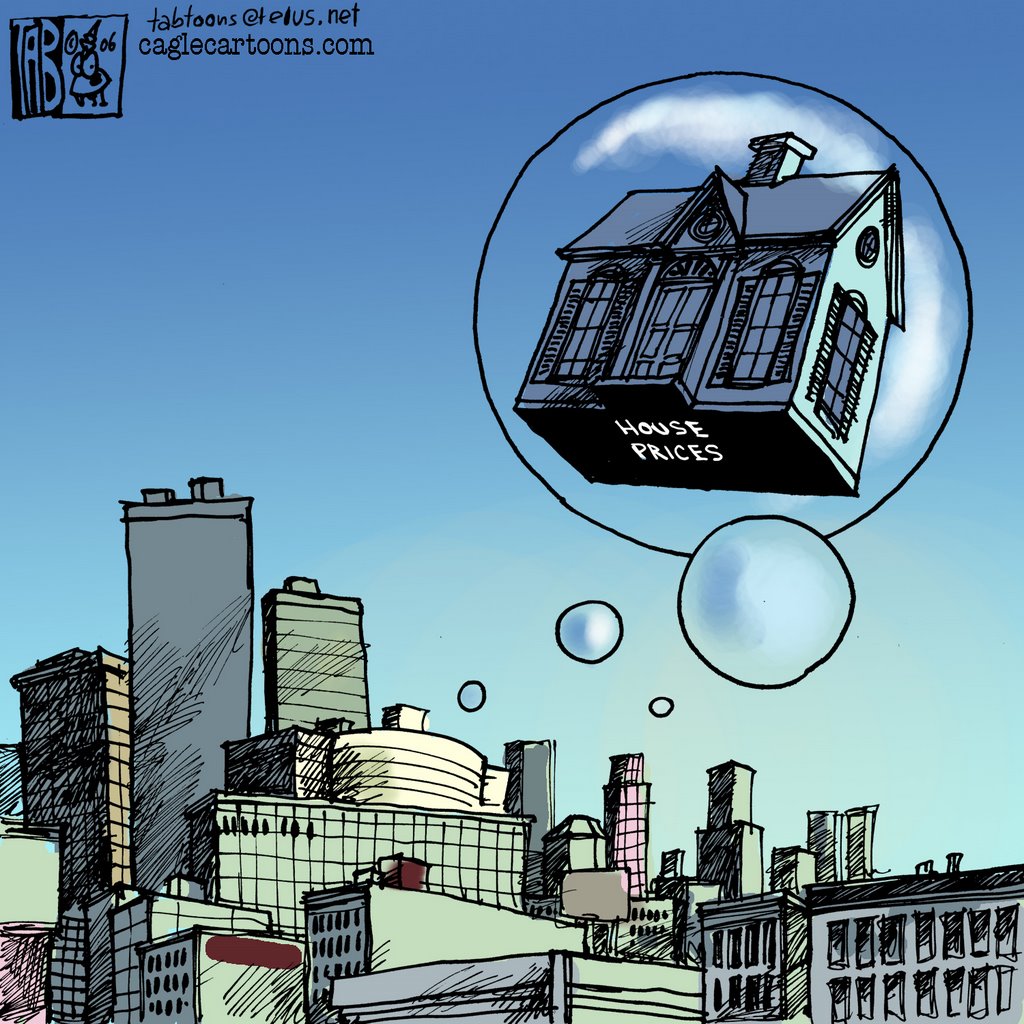
"Amid all the ups and downs in the housing data of late, how you feel about the direction of this year's most closely watched economic sector may well depend on which day of the week you check the news." You can read the full article by James Cooper entitled, "Housing: Where the market is really heading," in the July 10th issue of BusinessWeek.
"Looking past all the recent month-to-month noise in the numbers, it's clear that demand for both new and existing homes is down from last year's peaks, and that the growth rate of prices continues to slow. However, the drop in sales is not as steep as the data had suggested earlier in the year. Sales are declining in an orderly fashion, not collapsing, and that pattern will most likely continue for the rest of the year."
Here's what Christopher Cagan, PH.D., director of research at First American Real Estate Solutions, has to say in his paper entitled, “The Real Estate Cycle in 2006,” dated May 18, 2006.
“The residential real estate market stands at a pivotal position in the spring of 2006. Over the previous few years, home prices have risen rapidly almost everywhere. In many coastal areas, prices have more than doubled since 2000. In recent months, the market has returned to more normal conditions. In many places, the inventory of properties offered for sale has increased. Buyers no longer rush to meet or exceed the asking prices of sellers. In some cases sellers have reduced their prices. On the whole, price appreciation has slowed down or flattened, but there has been no crash. Depending on the local area, prices are rising at single-digit levels, flattening out, or slightly declining – in other words, conditions have returned to normal after a very strong bull market.”
Finally, David Lereah, the chief economist for the National Association of Realtor's was asked in an interview; "Do you think the housing market could ever crash?" Here's his answer;
"I'm getting tired of all these doomsayers. We live in houses, and our houses are not going to crash. This isn't the stock market.... Local economies are relatively healthy. There's job creation -- this isn't a scenario where bubbles burst. Can there be one or two or three or several local markets where prices actually go down? Yes. But to generalize for 30 markets or the whole real estate marketplace -- that's absurd."
"Why the Bubble Won't Burst," interview with Michael Youngblood, Managing Director of Friedman Billings Ramsey & Co.
Housing Bubble Prospects Question and Answers provided By NAR.
You can also view the Anti Bubble Reports on their website for Market-by-Market Home Price Analysis Reports.
Labels: Bay Area Real Estate, BusinessWeek, First American Real Estate Solutions, NAR, Real Estate Bubble, Real Estate Cycles
# posted by Glen Bell @ 12:32 PM location.href=https://www.blogger.com/comment/fullpage/post/19316683/115186928849619912;>0 comments


 Links
Links


